Tuesday, 19 April 2011

TASK FOUR: Who would be the audience for your media project?


My media project would probably be rated a 15 as characters are put into life threatening situations which would involve strong violence and frequent strong language. As no-one younger than 15 may rent or buy or see a ‘15’ rated film the audience age would be 15 and above. I presume that it would attract 15-25 year olds/ young adults as it is for a mature yet youthful audience because of it’s modern edge. 

It would also attract people who watch such programmes as Criminal Minds (Produces by ABC Studios) as it contains the same theme of Investigators trying to find a serial-killer/kidnapper.


As the film fits into the genre of a thriller it would attract thrill-seekers.


As the film is related to the Olympic Games (a world-wide event) it would attract a wide audience- stretching across different countries.


In 2012 the Olympic games is being held in London, this would be convenient as it could be released close to this time as it would be a theme present in the Media and would therefore attract more people. It is also convenient that it is being held in London as it would seem that a  British film relating to the Olympics would be a hot topic.

Monday, 18 April 2011

TASK THREE: What kind of media institution might distribute your media project and why?

-       My media thriller is full of isolation, suspense and intensity as it is a modern psychological thriller.
-       Out of the production companies which I have studied (Warner Bros., Warp Films and Vertigo Films) I found that Vertigo Films would be the most suitable institution to distribute my thriller.


-       Vertigo Films is an Independent British Film Company which was created in 2002. Vertigo creates many films within the “thriller” genre which have been very successful (such as Shrooms, Monsters, The Wake Wood etc.) all of which have the same elements as Immersed. Vertigo also creates many high-concept films with a very small budget (e.g Monsters and Street Dance). They are an independent company trying to become “main-stream”.


-       I believe Immersed would be appropriate to be distributed by Vertigo as it has been designed to appeal to a mass audience. The plot for Immersed is rather “safe” as it is rather un-original meaning that the basis of the plot has been seen before and audiences have proven to be drawn to this.

The Plot

A teenage girl a with big dream of swimming for her country in the 2012 Olympics is threatened by a fellow team mate who takes her hostage and her only hope is two Crime Scene Investigators saving her before time runs out.

There are two elements of this plot which are seen in previous Vertigo Films;

1)    In Street Dance a girl a teenage girl, Carly, and her friend who all have big dreams of becoming professional street-dancers. 


2)    In WAZ there are two investigators trying to find a serial killer. This film also involves an element of time pressure as “body’s” keep appearing and every moment lost is a life lost.


TASK TWO: How does your product represent particular social groups?

Throughout life we see particular social groups and stereotypes which all seems to begin at high-school/ secondary school.

We see this in such films as “Mean Girls” (produced by Paramount Pictures and directed by Mark Waters).
This idea that we must belong to a certain social group is prominent in society, especially in youthful years, as teenagers are trying to find their identity.

Two of the social groups listed in “Mean Gils” which relate to the character of the swimmer in my thriller sequence are;
-JV Jocks (a person who actively and competitively competes in sporting events)
-Varsity Jocks (a person who represents a university/college in a sports team)

However, the character of the swimmer in “Immersed” is a female obsessed with sports. This is therefore subverting the stereotype of the male obsessed with sports as the gender stereotype is reversed.

An American television drama series, Make It or Break It, focuses on the lives of teen gymnasts who strive to make it to the Olympic Games (Directed by Steve Miner and produces by ABC Family). This program is centered on females who aim to be in the Olympics. This is the same social group which is representing in my product.


People like Rebecca Adlington, the first British swimmer to win two Olympic gold medals since 1908, began swimming aged 4 and competing aged 10.
The social group, where such people as Rebecca Adlington belong is the social group which I am representing in my project. A group of girls who, from a young age, are committed, determined and obsessed with sports and hope to peruse it as a career.


As the main character in my sequence is a so obsessed/immersed in swimming she is distracted. She is therefore vulnerable.

This is also quite stereotypical, as the girl who is isolated, distracted and alone is shown to be vulnerable. We see many examples of this in adverts to warn teenagers to pay attention while crossing the road as they are usually listening to music on their IPod or texting on the phone. This stereotype of teenagers being distracted, unaware and vulnerable is also present in my product.

Below is video of this representation in tranpsot for london's advert for road safety where a girls dreams are "shattered" as she "dies before she lives" as she is unaware and distracted.


Monday, 4 April 2011

TASK ONE: In what ways does your media product use, develop or challenge forms and conventions of real media products?


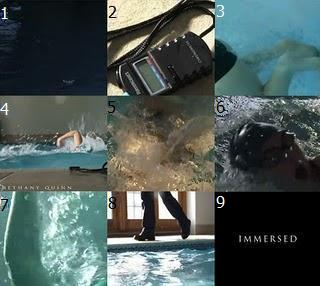
These nine images are all screen grabs from our thriller. They are in chronological order.

         1)This opening shot, personally, is my favourite. I chose to do this when we were originally creating the story board as when I watched the opening sequence to “Don’t Look Now” in class there is a shot held for several seconds zooming into the water/ river. In “Don’t Look Now” the water shot seems to be saying “there is something beneath the surface”. In “Immersed” there is this same effect as the stillness of the water is very eerie and makes the audience uneasy. This is the same way we feel throughout the opening sequence to “Don’t Look Now”. In “Don’t Look Now” the rain is constantly breaking the surface of the water but in “Immersed” the water is completely still until the girl dives into it and there is a loud splash, breaking the tension yet shocking the viewer.

         2)The shots of the stopwatch, which are continuously being showed throughout the sequence is the element of time which I hoped would be a theme throughout the film. This enforces and adds;
-The idea that time is running out.
This is seen in many programmes and films particularly in WAZ (Produced by Vertigo) where the two investigators must find out who the serial killer is before any more lives are lost.
-Tension.
It gives the audience foresight- showing them that something bad is going to happen.
This shot also shows the swimmers obsession with the sport and her strong desire to do her fastest time yet in order to get herself to the Olympics.

         3)This underwater shot of the girl doing a tumble turn adds to the theme of isolation as she is cut off from the “real world”- literally because she is underwater but metaphorically because she is distracted by her obsession of winning.

          4)We chose this shot of the girl swimming toward the stopwatch for a screen-grab because it illustrates our choice of font. We chose to have;
-Simple, sophisticated font.
We believed that the modern edge to the scene made it sophisticated and the naturalism and lack of dialogue in the scene made it simple. Therefore we chose the font which we thought fitted well with the scene.
We also thought it would be best to keep it simple as we didn’t want to hint, through the text, that the girl was in danger e.g. by using red font.
-The title placed on the tiles and other plain backgrounds
This made the font convenient as the viewer easily read the titles. I believe this to be very important because people spend moths/years working on films and they deserve to receive credit.

         5)This slow- motion shot of Bethany doing a tumble-turn is in order to;
-Cause confusion as the audience’s view of Bethany is obstructed by splashing water.
-Show the audience that Bethany is imagining herself in a swimming competition as often in races the competitors actions, good/bad are repeated in slow-motion.
-It also build up intensity and tension as time is slowing down showing the viewer to know that something bad is going to happen, and soon.

         6)This slow-motion of Bethany coming up for a breath was done in order to add to tension as the sequence comes to a climax. We also used a recorded sound of a girl breathing as (due to the slow-motion) Bethany’s breathing was very low and almost inaudible. By putting in this recording it added to the idea of desperation as it is a strong gasp for air. The breathing also sound quite internal reminding us that Bethany is completely immersed in the swimming and is completely unaware of what is going on.

         7)This shot is the second of two underwater shots which are disjointed and add to the confusion and discomfort of the scene. It also makes the viewer feel slightly disorientated and quite nauseous, again adding to the audience’s discomfort.

         8)This tracking shot of Adam’s feet again builds up the tension as he gets closer and closer. Along with the animalistic/tribal drumming the audience is made to feel uncomfortable, again, and possibly even fearful.

         9)We chose this shot as a screen grab as we spent a while using After Effects to make a very subtle ripple and reflection of the title. This adds to the theme of swimming/water-sports which is continued through the plot of Immersed as people from British swimming teams start to go missing.  

Saturday, 2 April 2011

My Media Opening Sequence- "Immersed"

The Shoot Day

-When we arrived at the location, on time, after creating a “shot list” (which helped us to organise ourselves for the day ahead of us) and gathering together all the equipment we needed for the day.

-For the "shot list" we went through our story board writing down the number of the shots which had the camera in the same position as another shot so that we wouldn't have to repeat the same shot several times. 

The Shot List looked something along the lines of this;

1 (shot of water)
2 (above shot of girl diving)
6, 12 (swimming along pool from side)
4, 17, 18, 24 (underwater shots)
3, 9 (Close-up of girl’s face while swimming)
10 (close up of feet kicking)
13 (wide shot of girl swimming towards stop watch)
14, 16 (of girl looking at stop watch from side of pool)
15 (POV from girl of stop watch)
19 (close up of bottom of opening door)
20, 22, 23 (following shots of Father’s feet and of father standing)
21 (wide shot of girl swimming)
25 (head on shot of girl coming to end of pool)
26, 28 (POV from father)
27 (POV from girl)
29 (girl getting out of pool)
31 (girl putting on towel- medium shot)

The photo above is of us using our shot-list which is in the folder we created. The folder consisted of the story-board, the cast-list, location photos, letters of permition, the plot etc. 

-We began as soon as we had set up the equipment and had the team and actors were “standing by”. 

The above photo is of the tracks which we layed down for our tracking shot.


The above photo is of me setting up the tri-pod onto the track for the tracking shot.


When we did a practice shot we realised that the camera was much too high for our ideal shot.


 We then decided to tape the camera to the bottom of the tri-pod in order to get the shot we'd hoped for. However, we found this shot diffiuclt as we wanted to assure that there was balanced camera movement and wanted tothat the actors feet were in frame the whole time. Finally, after several takes we finally got the right shot.

-I enjoyed filming as I could remeber everything we were initially taught about camer-work. It was also very exciting as I learnt how to create a slow-motion shot.
The photo to the right is of a wide-shot through the camera.
The photo to the left is of me filming the wide-shot of Bethany swimming in the pool.

-We were happy with our choice in actors as Bethany, in particular, was very easy to work with. Even though she had to do a lot of continuous swimming she worked her hardest in order to not waste shooting time. 

The photo above is of me talking to bethany whilst the group is preparing for the next shot. I realised the importance of assuring that the actor knows what the crew's intentions are, before the shot, in order for them to give it their best effort. I learnt that communication between the actor and the crew is very important.

 Above is a photo of bethany. We assured that she was comfortable/ ready to begin the next shot as it can be very tiring swimming length after length without a proper break. By giving Bethany this time for a "breather" it allowed her to perform her best leaving Bethany and crew very happy with her work at then end of the day.

-On the day, as we were seeing the location first-hand for the first time, we came up with lot of new ideas for shots which we were very happy with.

e.g an ECU underwater shot of Bethany's hands (as shown below) and body as she is swimming which was very disorientating to the audience and added to the unnerving aspect of the sequence.
-We worked very well together as a group and found that our planning helped us hugely in terms of organisation as we finished with time to spare.

The photo above is of us planning which shots to do at what time and when would be an appropriate time for breaks. 

Problems which we experienced on the day were;
- Some shots which we had originally planned to do wouldn't be possible as we were seeing the location, first hand, for the first time.

e.g an underwater shot of the girl diving into the pool as the length and width of the pool wasn't large enough to create the sought after shot.


- The lighting in the room constantly changed as we were using natural lighting (the sun).
e.g we had difficulties with the exposure setting on the camera as the lighting could change mid-shot and then the exposure would be too high. We also noticed that this would create problems for us later in editing as the lighting would change throughout the sequence.


This is a picture of a friend who we asked to hold a towl up to the window in order to block the sunlight so that the exposure didn't change during a shot. This was a done as a last resort because we hadn't thought about problems with natural lighting in our preperation.


In Conclusion, I learnt many things, some of which to do again and others never to do again. It was a great exeperience and I am looking forward to editing the shots to creat my thriller sequence.

Some Examples of our Storyboards- Immersed


Friday, 1 April 2011

The Cast List for the updated media thriller

We came to a final decision of name the thriller, "Immersed", while  changing the plot; a teenage girl fighting for her chance in the olympics however she caught and is kept hostage by one of her competators and two crime scene investigators must do their best to find her before time runs out.

Name: Adam Grant
Age: Early 30’s
Sex: Male
Role: Kidnapper/ Male Olympic Swimmer

Reasons for Casting: Adam has the appearance of someone sporty. He is also willing to act and has been in previous media videos and therefore has had experience acting.

Contact info;
E-mail:Adam.grant@hurtwood.net


Name: Bethany Quinn
Age: 16
Sex: Female
Role: Female Olympic swimmer

Reasons for casting: She has a swimmers physique as she was on the swimming team of her old school. She has experience in swimming and acting (AS Theatre Studies). She is fit enough to do continuous swimming as she does dance AS. She is comfortable with being filmed in a swim suit. She fits the age we are looking for. 

Contact info;
E-mail: Bethany.quinn@hurtwood.net

Tuesday, 15 February 2011

Who is the target audience for my media project?

              
-Our thriller would be targeted at a mature teenage audience as the characters are mostly teenagers.
- It wouldn’t be suitable for people under the age of sixteen as it would involve a lot of psychological trauma.

- I would say that most common type of people that would watch this would be rather generic as the idea itself isn’t particularly original therefore it could be viewed by many teenagers as it is has a “safe” plot (it’s been done before therefore we know that people will like it) quite like in most Hollywood blockbusters where the film is rarely original.

-People who watch such films as “When a Stranger Calls”, “Rear Window” and “Strangers” are likely to enjoy “The Deep End” film because it uses the same ideas of the intruder/stalker, being watched, ignorance and isolation etc.


People would want to continue to watch our film after the opening sequence as it;

-Sets the scene; we are introduced to Bethany and are shown the most important thing in her life is swimming for her county.

-Has an element of danger; after we become acquainted with Bethany and her lifestyle and then we are shown that she is in danger (she is being watched by a dangerous man)


-Has an aspect of excitement; we are shown from shots such as the slow motion shot of Bethany coming up for a breath that her life is intense and exciting which makes the film interesting.


Tuesday, 1 February 2011

ESSAY- Analysing the Opening Sequence of Don't Look Now


- The opening shot is of a murky river in a field while it is raining. The rain is breaking the waters surface which makes the viewer imagine what is underneath the surface.

 
-The shot then zooms in closer to the water as if to imply that there is something inside it.

 
- The sound of rain hitting the water (diagetic) is very loud, drawing your attention to the water and then to what is in it. This is very effective as the audiences imagination takes over and begins to wonder through the subconscious, slowly building the suspense throughout the scene.

 
- There is a shot of light shining in through window-shutters. The viewer suspects the window to be a window of a church. This then adds a religious element to the scene.


- The diegetic sound of a man humming adds to the eerie effect as it seems quite creepy and out of place, quite childlike.

 
- In a shot of the girl walking with a wheel barrow a white horse runs across the field which seems quite out of place. The horse seems quite magical, adding a sense of innocence, as if it where a unicorn in a fairy-tale.


-The music in the scene (girl walking with wheel-barrow) adds to the idea of innocence as we are reminded of the girls youth as it is quite a childlike piece. The music also adds an uneasiness as the piano playing is quite disjointed.


-Overall it is very eerie as it has a constant sense of danger which is suspended until the very end of the scene.


-The early morning mist adds to the Mise-en-Scene as it adds a slightly spiritual haze to the scene.

 
-The lighting in most of the sequence is natural as it is from the rising sun.


- Low angled shot of the girls silhouette, this is very effective as it adds a religious, angelic view-point of the girl as she is standing in the bright morning light creating a presence of death/angels which seems to be a representation of heaven/the after-life.

 
-In order to show the isolation of the little girl there are shots of the girl in the foreground and the house in the background showing her distance from everyone else.


-There is a shot where her brother turns to look at her in the foreground and then turn his back on her. This forces us to notice that no-one is watching her which gives the sense that anything could happen.

 
-There is a long, wide shot of the young girl’s reflection in the water as she is running along the bank. This then makes the viewer uneasy as you cannot see the angle of the ground she is standing on which makes us believe she could fall into the water at any moment.


- The long-shot gives the viewer a subtle foresight to the tragic event which occurs later in the sequence, which adds to the suspense.

 
-The shot of the boy is uncomfortable as he continuously moves from right to left making it hard for the viewer to keep their eyes on him, it’s quite an uncomfortable image.


-When the boy rides over the broken glass was elevated to make us jump as we have been concentrating on the boy. This adds to the viewer's discomfort.


-Overall the sound in the scene makes the audience feel uncomfortable by the volume of noises made varying constantly. (E.g  the doll is so loud that the viewer feels rather disturbed and there is a loud sound of sticks cracking when the girl is walking.)


-There are scenes, between the girl and the boy playing, which are inside with what we assume are their parents. These shots give us a break from the suspense and allow us to look over the situation.


-The shot zooms into the figure in the red coat and then match cuts to the young girl in the same red coat outside therefore she is the same figure in the image.


- In the photo the girls back is to her father as if they are separated from each-other, the harsh red colour seems out of place in the church therefore our attention is drawn to the child.

-The angle of the photo is low, this makes the figure seem quite powerful, spiritual.


-There is a sense of mystery and the unknown as the girl is hooded therefore her coat is covering all her features, including her body, as if the figure is in the afterlife; reminding us that the girl will soon be dead.

 
- Looking for her cigarettes, the mother, puts her hand to her mouth, the scene then match cuts to the girl with her hand to her mouth; showing us that there is a connection between the two characters giving us the sense of a hidden identity within both people.

 
- The father knocks over his glass it cuts to a shot of the ball falling into the water. The water spilling seems to represent the end of his daughter’s life as it is quick and swift and the girl has been related to water since the beginning of the scene.


- The idea of the water spilling and then the girl dying is quite superstitious which then adds to the overall ambience of spiritual presence.


-When the glass drops the noise is again uncomfortably loud, making the viewer alert.


-When the red-ink of the girl’s coat, on the photo, begins to run through the rest of the image it greatly implies spiritual presence. As if the daughter’s soul is leaving her body, It also seems to represent blood and death; red tends to be a typical representation of this.


-The short-shot of the little girl falling into the water, in slow motion is very effective as we have been waiting a long time for the girl to fall into the water. 


-We do not associate emotionally with the child as our expectation of her death has been building. This then leads the viewer to believe that there was an alternative reason for the girl falling into the water.


- There is a long-shot of the father trying to find his daughter in the water. This puts the viewer on edge as we want him to find his daughter quickly incase he can save her, although we know that it isn’t likely to happen.

In evaluation of the opening scene to "Don’t Look Now" is very effective as it builds suspense and the finally has a climax while adding a spiritual factor to the film and making the audience feel uneasy and confused